Benefits of Actiphage as a test for Johne's Disease
Actiphage offers many benefits for herd management:
- Provides a clear yes or no test result
- Test result is available in a few days
- Not impacted by short interval TB testing
- Enables actionable insights.
Regular testing with Actiphage provides evidence of a disease-free status.
Addresses the two main causes of Johne’s Disease
Cause of infection 1: Johne’s Disease is transmitted from infected cow to calf.
Testing cows with Actiphage before calving will identify those with active infection even before clinical symptoms are apparent. Isolating infected cows at calving, not sharing colostrum, and breeding only to beef to remove calves from herd, is an effective strategy for removing the disease from the herd. This is now possible with Actiphage.
Cause of infection 2: Johne’s Disease is introduced to herd by infected animals.
Testing cattle with Actiphage before purchase and only buying stock from farms known to be free of Johne’s, will reduce the risk of disease.
How Actiphage supports early detection of live infection
Johne’s is an infectious disease that typically passes through four stages. (Fig 1) For each animal showing clinical symptoms it is estimated that three are at Stage II, so early detection with Actiphage can help manage the disease risk.
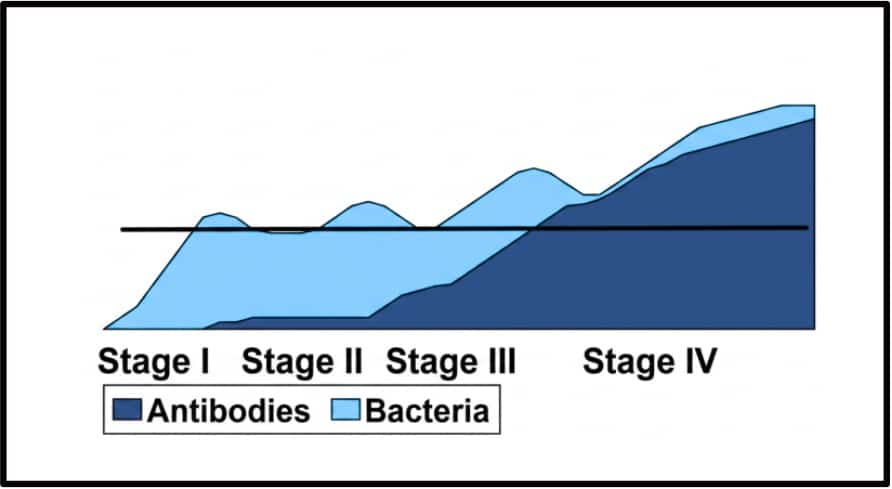
Stages of Johne's Disease infection. Credit Cornell University
- Stage I initial infection: controlled by immune system and no signs of disease.
- Stage II infection progresses: no clinical signs but infectious to other animals. Rarely has antibodies detectable by serology, but bacteria may be excreted in faeces in high enough numbers for detection by culture. Bacteria in blood detectable by Actiphage.
- Stage III early signs of disease: producing antibodies detectable by ELISA and by other diagnostic tests that use an immune response. Actiphage can differentiate animals with active disease from those that have had recent contact with infected cattle.
- Stage IV clinical disease: Cattle should be removed from herd.
Supporting the National Johne’s Management Plan
Actiphage provides the information required to introduce an effective National Johne’s Management Plan (NJMP). And, if Actiphage is used to test new stock, it minimises the risk of introducing diseased animals into the herd.
Although the NJMP is currently voluntary, as evidence grows of the link between Johne’s Disease in animals and Crones Disease in humans, it is anticipated that it will be advantageous for farmers to show they have a NJMP in place. Regular testing with Actiphage provides evidence of a disease-free status.
Actiphage can be used to give more accurate information about the disease status of a particular animal, or to screen a herd that includes animals with a history of poor yields, weight loss or high somatic cell counts.
Farmers and vets are increasingly using the JD Tracker, developed by the Veterinary Epidemiology and Economics Research Unit (VEERU, University of Reading) and supported by the National Action Group on Johne’s (Orpin et al., 2022) to determine the prevalence of Johne’s Disease in the herd.
Actiphage can inform the management strategy by providing further information about individual animals or to test bulk milk.